
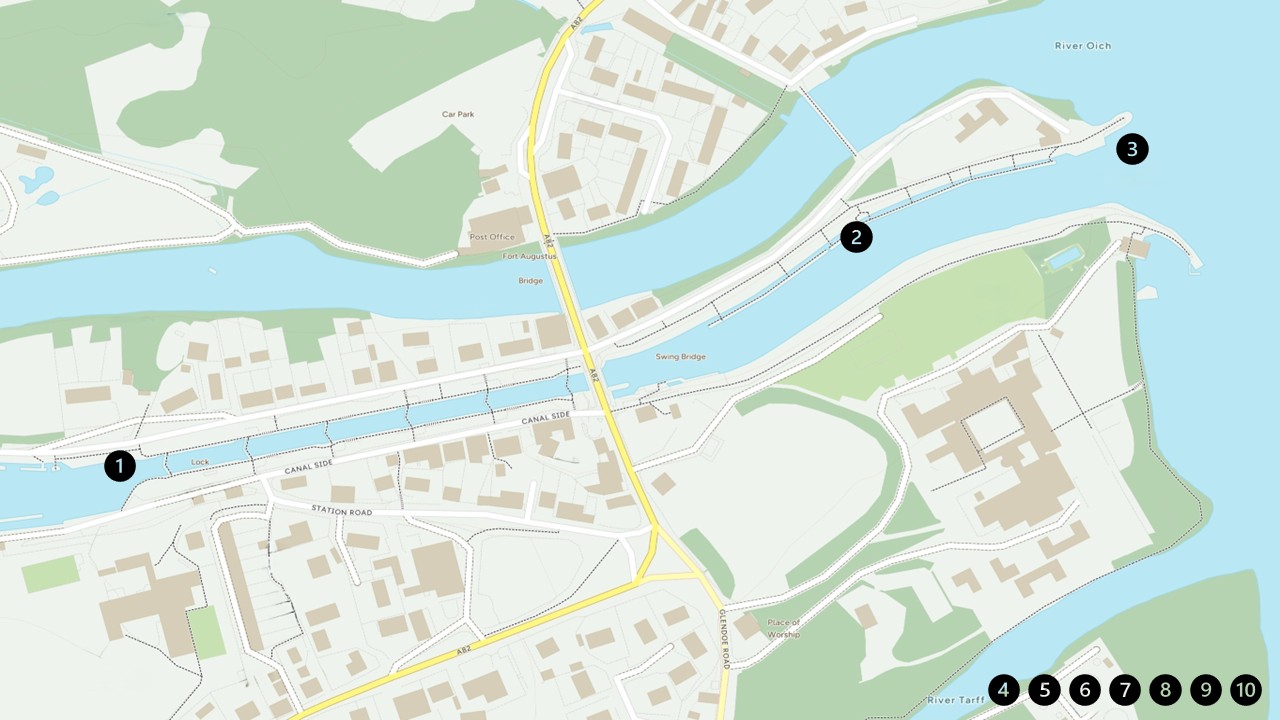
1. Railway Bridge
You are now standing at the site of the original railway crossing over the Oich river. Looking away from the canal, through the bushes, lies the path of the Inver-Garry and Fort Augustus Railway which operated from 1903 until 1947. Although you cannot see this from your current position, imagine the track laid over the small bridge in front of you then majestically spanning the whole of the river beyond until it reaches the Pier Station ahead.
The station was intended to allow freight and passengers to then continue up the Loch to connect Fort Augustus to inverness beyond. Sadly this was never achieved and the station is long gone with the bridge over the Oich being the only reminder of that age.
The remaining pillars of the railway crossing can still be seen from the road bridge which was built and opened to traffic in 1935.
2. Oich Road
You are now standing on land between the Caledonian Canal
and the River Oich on the other side of the road. Looking over the Canal you
can see, between the trees, the Clock Tower of the old St Benedict’s Abbey
which was remodelled by Peter Paul Pugin in the 1880’s. The Abbey was built on
the site of the former Fort which was constructed in 1729, and today much of
the fort still exists in the current structure. The fort was significantly altered
when the Benedictine monks were bequeathed the site by Simon Fraser, 13th
Lord Lovat in 1876. The buildings are now accommodation and holiday apartments.
Turning around and crossing the road you will see the old
Oich Bridge. This picturesque, and now sadly derelict structure, was the
replacement crossing over the River Oich for an original stone bridge that was
washed away in the storms of 1849. An original stone arch can be seen on the
other side of the river. Joseph Mitchell, a pupil of Thomas Telford, redesigned
and oversaw the construction of the replacement bridge you see today although he
only envisaged this being a temporary structure.
3. Viewpoint
In front of you is the majestic expanse of the world-famous
Loch Ness. The Loch is the second largest Scottish Loch by surface area but due
to its depth of 230 metres, it can hold all the water from all the lakes in
both England and Wales combined. To the left, behind the rock and trees lies
the remains of the Old Pier Station which is where the Invergarry and Fort
Augustus Railway terminated during its short-lived operation from 1903 until
1947. On the right you can see the old Boathouse for the Abbey when it was a
School until its closure in the 1990’s, and also the lighthouse for guiding
craft into the mouth of the Caledonian Canal.
Ahead of you, 35 miles further down the Loch, is Inverness,
the capitol of the Highlands, where the Caledonian Canal completes its northern
journey into the Moray Firth and out to sea.